Used Track Skid Steer for Sale: Are CTLs Worth It?
Used Track Skid Steer for Sale: Are CTLs Really Worth the Premium?
If you have been searching for a used track skid steer for sale, you already know the sticker shock. Compact track loaders command 20 to 35 percent more than their wheeled counterparts on the used market, and that gap barely narrows with age. A five-year-old Bobcat T770 still fetches noticeably more than an equivalent S770 with similar hours. The question every contractor, landscaper, and farmer needs to answer before writing that check is whether the extra money actually buys extra capability for the work you do. CTLs are not universally better than wheeled skid steers. They are better at specific things, and those things may or may not match your operation. This article walks through the real costs, the genuine advantages, the maintenance reality, and the scenarios where a used track skid steer for sale is the right call versus when you should save your money and stick with tires.
Why CTLs Cost More on the Used Market
The price premium on compact track loaders is not just dealer markup. It reflects higher manufacturing costs, stronger resale demand, and a market that has shifted decisively toward tracks over the last decade. CTLs now account for the majority of the combined North American skid steer and compact track loader market, which was valued at $15.2 billion in 2024. That demand keeps used prices firm.
A used wheeled skid steer in the 70 to 90 horsepower range typically runs $15,000 to $35,000 depending on hours and condition. The same class of CTL will run $22,000 to $50,000. The gap widens on premium models. You will see Bobcat T770s and Kubota SVL97-2s holding value stubbornly because rental fleets and contractors snap up clean units fast.
The higher new price also plays a role. New CTLs run $60,000 to over $150,000 depending on size and configuration. That anchors used pricing higher across the board. Add in the fact that tracks wear out and need replacement, which means a used CTL with fresh rubber commands even more, and the market starts to make sense even if it does not make your wallet happy.
Bottom line: you are paying more because more people want these machines. That is not going to change anytime soon.
The Ground Pressure Advantage
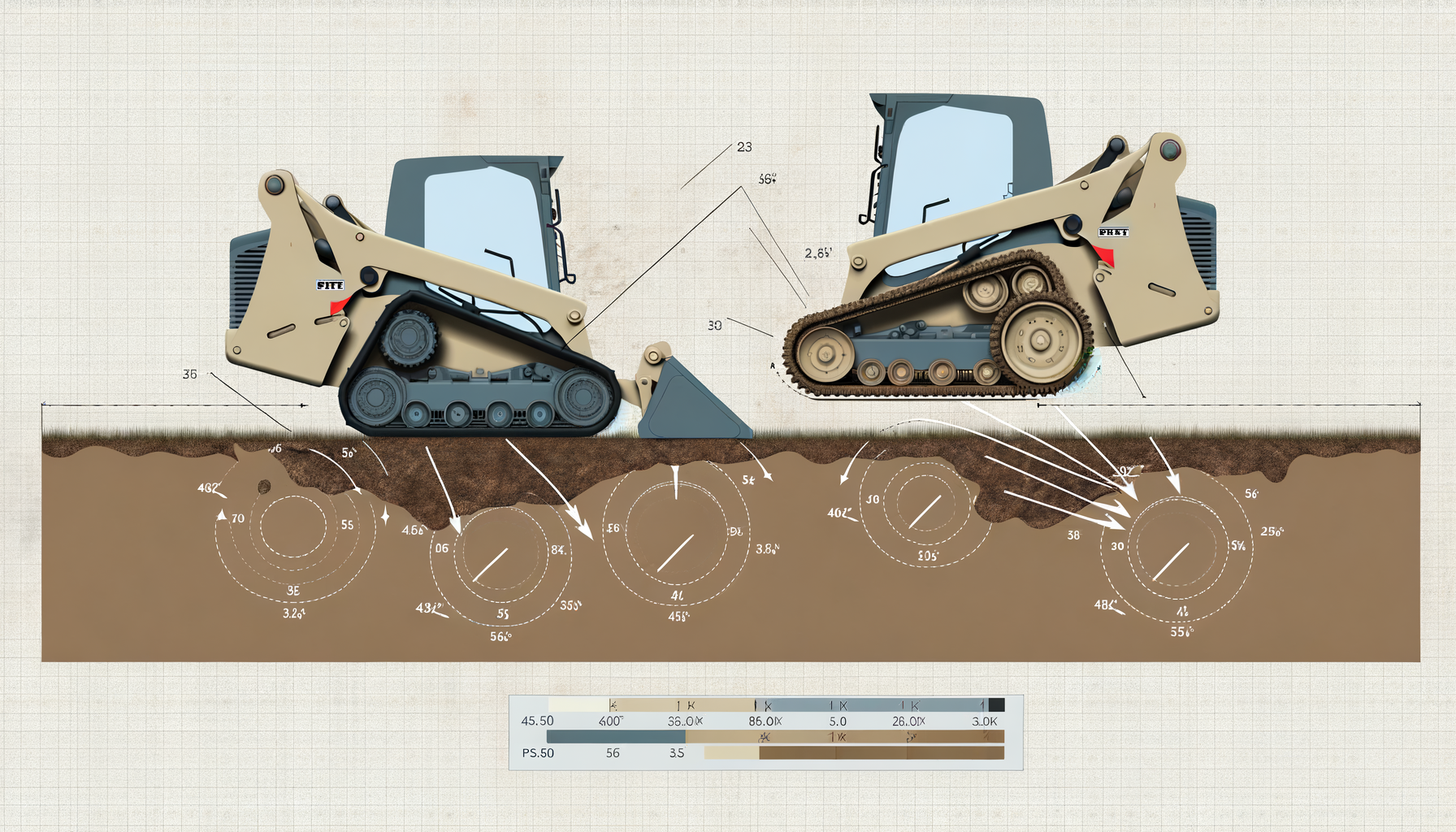
This is where CTLs earn their premium for the right buyer. A compact track loader puts down 4 to 6 PSI of ground pressure. A wheeled skid steer? You are looking at 10 to 15 PSI. That difference is not academic. It is the difference between floating across a rain-soaked jobsite and sinking to the axles.
Tracks spread the machine's weight across a much larger footprint, which lets you work in conditions that would sideline a wheeled machine entirely. Soft soil, mud, sand, fresh gravel, wet clay, and even snow become manageable terrain. A John Deere 317G with the optional 15.8-inch wide track drops to just 4.5 PSI, letting you grade on ground that would swallow a wheeled machine.
The traction numbers back this up too. CTLs deliver roughly 30 to 50 percent better traction than wheeled alternatives, which translates to real productivity gains of 15 to 25 percent in soft or uneven terrain. If you are a landscaper working new construction sites in spring, a farmer moving feed across muddy pastures, or a contractor grading after rain, those numbers hit your bottom line directly.
One more thing most people miss: lower ground pressure means less turf damage. If you are working on finished lawns or sensitive ground, tracks leave a lighter footprint than you would expect from a 9,000-pound machine.
Best Used CTL Models Worth Buying
Not every used track skid steer for sale is a good deal. Some models have earned their reputation, and some have earned a reputation you want to avoid. Here are the ones that consistently deliver on the used market.
Bobcat T770 / T870. The T770 runs a 92-horsepower engine with a 3,475-pound rated operating capacity and a vertical lift path that reaches 11 feet. It is the go-to mid-large CTL for a reason. The non-DPF engine option on older models cuts maintenance headaches significantly. The T870 steps up for heavier work. Both models have excellent parts availability and dealer support. Tilting the cab for hydraulic access requires just two nuts and no specialty tools, which is a maintenance win.
Kubota SVL97-2. Puts out 96.4 horsepower with one of the smoothest power deliveries in the class. Kubota's reputation for serviceability is deserved here. Components are accessible, the build quality is consistent, and the machines hold up well at higher hours. Good breakout force for the size.
Cat 259 / 289. The Cat 259 sits in the mid-range with around 73 horsepower, while the 289 pushes into the high-90s. The open undercarriage design on Cat CTLs makes cleaning out packed mud noticeably easier than competitors with enclosed designs. Higher parts cost than Bobcat or Kubota, but the machines are built heavy.
John Deere 333G. The large-frame option if you need serious pushing power. Deere's dealer network is hard to beat in rural areas, and the 333G has proven durable in heavy applications. Just make sure the emissions system has been properly maintained on Tier 4 Final models.
When shopping used, prioritize machines with documented service records and check undercarriage condition before anything else. A low-hour machine with a trashed undercarriage is not actually a deal.
Maintenance Reality Check
Here is where the honest conversation about CTLs gets uncomfortable. The undercarriage is the single biggest maintenance expense, and it is an expense wheeled machines simply do not have.
Rubber tracks on a compact track loader last roughly 1,200 to 1,500 hours when properly maintained. A set of replacement tracks runs $2,000 to $5,000 or more depending on the model and whether you go OEM or aftermarket. Beyond the tracks themselves, you have sprockets, idlers, and rollers that wear and eventually need replacement. General undercarriage operating costs run around $10 per hour, which adds up fast on a machine running 800 to 1,000 hours a year.
Compare that to a wheeled skid steer where a set of four tires costs $800 to $1,500 and lasts a similar number of hours on hard surfaces. The math is not close.
Daily maintenance matters more on a CTL too. You need to clean packed material out of the undercarriage regularly, check track tension, and inspect for cuts or damage. Ignore this and you will eat through tracks in half the expected life. Running a CTL on pavement or rock accelerates wear dramatically. If your primary work surface is hard, you are literally grinding money off the bottom of your machine every day.
Suspension versus rigid undercarriage is another factor on used machines. Suspended designs ride smoother but have more parts that can wear and fail. Rigid frames are simpler and cheaper to maintain but rougher on the operator at speed.
When Wheels Actually Make More Sense
Not every job needs tracks, and buying a CTL for the wrong application wastes money on day one and every day after. Here is when a wheeled skid steer is the smarter used purchase.
Primarily hard-surface work. If 80 percent or more of your operating time is on concrete, asphalt, or compacted gravel, tracks are a liability. They wear faster, they are slower in travel, and they cost more to maintain. A wheeled skid steer on hard surfaces will outrun a CTL in travel speed and cost a fraction to keep rolling.
Tight budget operations. The 20 to 35 percent price premium on a used CTL could buy you a significantly nicer wheeled machine or leave money for attachments. If your work does not regularly involve soft ground, that premium is buying capability you will never use.
High travel between job sites. CTLs are slower on the road and harder on trailers. If you are constantly loading, trailering, and unloading, the extra weight and slower travel speed adds friction to your day.
Paved property maintenance. Parking lots, warehouses, and municipal work on finished surfaces chew through rubber tracks. Tires are cheaper, faster to replace, and better suited to the work.
The honest answer for a lot of buyers comparing wheeled and tracked options is that a wheeled machine handles 70 percent of what a CTL can do at significantly lower operating cost. The question is whether your 30 percent justifies the premium.
Key Takeaways
- Used CTLs cost 20 to 35 percent more than equivalent wheeled skid steers, and that gap holds because demand is strong and climbing.
- Ground pressure of 4 to 6 PSI versus 10 to 15 PSI on wheels is the core advantage. If soft ground is your reality, it is not a luxury; it is a productivity requirement.
- The Bobcat T770, Kubota SVL97-2, Cat 259/289, and John Deere 333G are the models that consistently hold value and deliver reliability on the used market.
- Undercarriage costs are real. Budget $2,000 to $5,000 for track replacement every 1,200 to 1,500 hours, plus ongoing roller and idler wear.
- If your work is primarily on hard surfaces, a wheeled skid steer will do the job cheaper and with less maintenance hassle.
- Always inspect undercarriage condition first on any used CTL. Fresh tracks inflate the price, but worn tracks mean an immediate reinvestment.
Conclusion
A used track skid steer for sale can be one of the best investments a contractor or farmer makes, but only if the work actually demands what tracks deliver. The ground pressure advantage is real and quantifiable. The productivity gains on soft terrain are significant. The resale value stays strong. But the maintenance costs are equally real, and buying a CTL for hard-surface work is like buying a four-wheel-drive truck to commute on the highway. You can do it, but you are paying for capability that sits unused. Match the machine to the ground conditions you actually face, check that undercarriage before you check anything else, and factor in the full cost of ownership, not just the purchase price. Do that and a used CTL will earn its keep.