What Does a Used Skid Steer Loader Actually Cost?
SkidInfo Team 7 min read
## What Does a Used Skid Steer Loader Actually Cost?
If you're shopping for a skid steer loader used, the sticker price is just the starting point. The real question isn't "how much?" — it's "how much for what?" A $15,000 machine with 4,000 hours on it tells a very different story than a $45,000 unit with 600 hours. Understanding the full cost picture before you buy keeps you from overpaying or, worse, picking up someone else's money pit.
This guide breaks down real-world pricing, what drives those numbers, and the costs most buyers overlook until it's too late. Whether you're a contractor, landscaper, or farmer, here's what the used skid steer market actually looks like right now.
### What Determines Used Skid Steer Pricing?
Five factors drive the price of any skid steer loader used on the secondary market:
**Brand and model.** Premium names — Bobcat, Caterpillar, John Deere — hold value better than budget brands. A used Bobcat S650 typically sells in the $20,000 to $30,000 range, while a comparable Cat 262D sits closer to $40,000. Brand reputation directly affects resale, which matters if you plan to trade up later.
**Operating hours.** This is the single biggest variable. The industry rule of thumb: once a skid steer crosses 1,000 hours, value drops fast. A machine that cost $30,000 new might sell for $20,000 to $22,000 after hitting that mark. Past 3,000 hours, prices flatten further as buyers start pricing in major component replacements.
**Age and generation.** Newer Tier 4 Final emission systems, pilot joystick controls, and pressurized cabs all command premiums over older machines. A 2018 model with 1,500 hours will outprice a 2012 model with the same hours by a significant margin.
**Attachments and configuration.** High-flow hydraulics, enclosed cabs with heat and AC, ride control, two-speed transmission — these options added $5,000 to $15,000 when new, and they still affect used pricing. A stripped-down open-cab unit and a fully loaded enclosed machine are essentially different products.
**Regional market conditions.** Snow states see higher demand (and prices) in fall. Construction-heavy metros push prices up year-round. Rural areas with less dealer access sometimes have lower prices but higher transport costs.
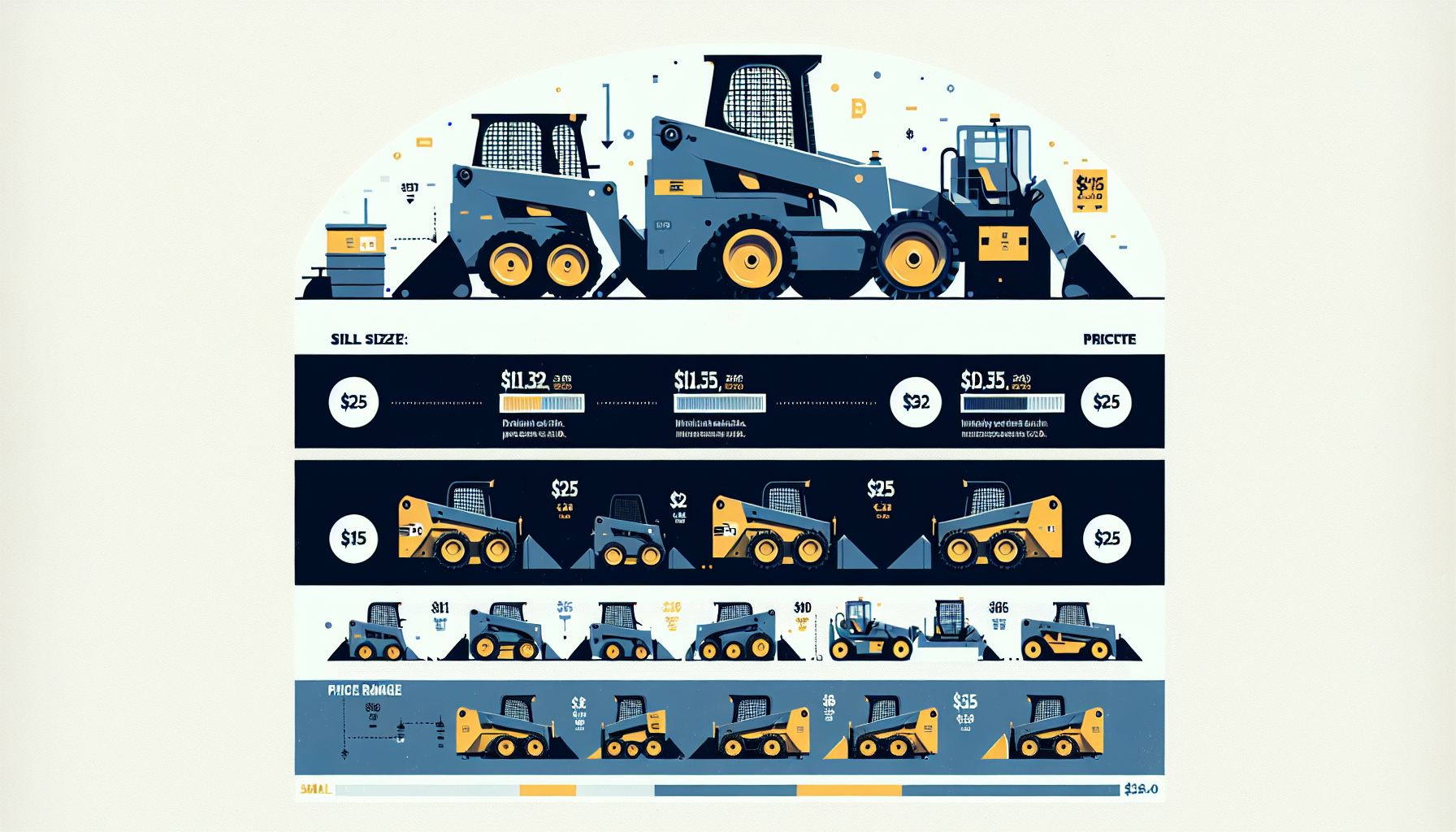
### Price Ranges by Size and Class
Used skid steers generally fall into three size categories. Here's what the current market looks like based on [auction and dealer data from Purple Wave](https://www.purplewave.com/blog/skid-steer-cost-guide):
**Small frame (1,300-1,750 lb rated capacity)**
These compact units — think Bobcat S70 or S100, John Deere 312GR — are the entry point. Used pricing typically runs $8,000 to $25,000. Best for light landscaping, hobby farms, and tight-access residential work.
**Mid-frame (1,750-2,200 lb rated capacity)**
The workhorse category. Models like the Bobcat S650, Case SV280, and Kubota SSV75 dominate this class. Used prices range from $20,000 to $50,000 depending on hours and configuration. This is where most contractors and landscapers land.
**Large frame (2,500-3,400+ lb rated capacity)**
Heavy-duty units like the Cat 272D, Case SV340B, and New Holland L328. Used pricing runs $35,000 to $70,000+. These machines handle demolition, large-scale grading, and serious material handling.
As a general benchmark, used skid steers sell for roughly 50% to 70% of their original retail price, though low-hour, well-maintained units from premium brands can hold closer to 75%.
### How Hours and Condition Affect Value
Hours on a skid steer are like miles on a truck — they tell you a lot, but not everything.
**The depreciation curve.** After 500 hours (roughly one year of average use), a skid steer retains about 70% to 75% of its original value. At 2,000 hours, expect 50% to 60%. Beyond 3,000 hours, you're looking at machines priced primarily on remaining component life rather than original cost.
**But hours alone aren't enough.** A machine with 2,000 hours of pallet work on concrete looks very different from one with 2,000 hours of demolition and land clearing. The type of work matters as much as the quantity. Always ask what the machine was used for, not just how long.
**Condition red flags that crush value:**
- Excessive play in loader arms or bucket pins (worn bushings)
- Hydraulic leaks at cylinder seals or hose fittings
- Cracked or spider-webbed cab glass
- Tracks or tires with less than 30% life remaining
- Warning lights, error codes, or aftermarket wiring
If you're buying from a private seller and want a more thorough checklist, our guide on [how to buy a used skid steer without getting burned](https://skidinfo.com/buy-used-skid-steer-guide) covers the full inspection process.
### Hidden Costs Beyond the Sticker Price
The purchase price gets you a machine. Actually putting it to work costs more. According to [ownership cost analysis from Equipment World](https://www.equipmentworld.com/construction-equipment/compact-equipment/skid-steer-loaders/article/15819941/skid-steer-buyers-guide-2026), total cost of ownership goes well beyond the monthly payment.
**Transport.** Getting a skid steer to your shop or jobsite runs $500 to $2,000+ depending on distance. You need a trailer rated for the machine's weight (7,000 to 11,000 lbs) and a truck that can pull it. If you don't own a rig, factor in delivery fees or trailer rental.
**Insurance.** Physical damage and liability coverage for a skid steer loader used commercially runs $800 to $2,500 per year depending on the machine's value, your location, and your claims history. Inland marine coverage — which protects during transport between sites — adds to that. Skipping insurance is a gamble most professionals can't afford.
**Maintenance.** Budget $1,500 to $3,000 annually for routine service: engine oil, hydraulic fluid, filters, greasing. Skid steers in dusty or demolition environments chew through filters and fluids faster. Tires run $200 to $600 each; a full set of tracks costs $1,500 to $4,000.
**Repairs.** Hydraulic pumps, drive motors, and final drives are the big-ticket items. A hydraulic pump replacement can run $2,000 to $5,000. Drive motor failure hits similar numbers. On a high-hour machine, these aren't hypothetical — they're inevitable.
**Fuel.** Most skid steers burn 1.5 to 3 gallons per hour depending on size and workload. At current diesel prices, that's $7 to $15 per operating hour.
**Attachments.** A bare machine needs buckets, forks, or whatever tooling your work requires. Used attachments help, but budget $1,000 to $5,000 depending on what you need.
### Getting the Best Deal
Finding a fairly priced skid steer loader used takes patience and some strategy:
**Buy in the off-season.** Late winter and early spring typically see lower demand in northern markets. Contractors selling at year-end to manage tax liability can be motivated sellers.
**Auctions vs. dealers vs. private sellers.** Auction prices are often 10% to 20% below dealer retail, but you get no warranty and limited inspection time. Dealers charge more but may offer 30-90 day powertrain coverage. Private sellers are a mixed bag — you can find the best deals and the worst surprises.
**Get a maintenance history.** Machines with documented dealer service records are worth the premium. Telematics data from brands like Cat, Deere, or Bobcat can verify actual hours and flag fault codes.
**Don't ignore financing.** Used equipment loans typically run 6% to 10% interest over 48-60 months. On a $30,000 machine, that adds $4,000 to $8,000 in interest. Factor that into your total cost, and don't overlook Section 179 deductions that offset the tax hit in year one.
**Negotiate on what matters.** If a machine needs new tires, a windshield, or upcoming scheduled service, use those as leverage. Sellers expect negotiation — the listed price is rarely the final price.
### The Bottom Line
A used skid steer costs somewhere between $8,000 and $70,000 depending on size, brand, hours, and condition. But the real cost — including transport, insurance, maintenance, and repairs — adds 15% to 30% on top of the purchase price in the first year alone. Run the numbers for your specific situation before you commit.
Start with a clear picture of what you need the machine to do, then work backward to the right size class and budget. A well-bought used skid steer is one of the best investments in your operation. A poorly bought one drains cash for years.